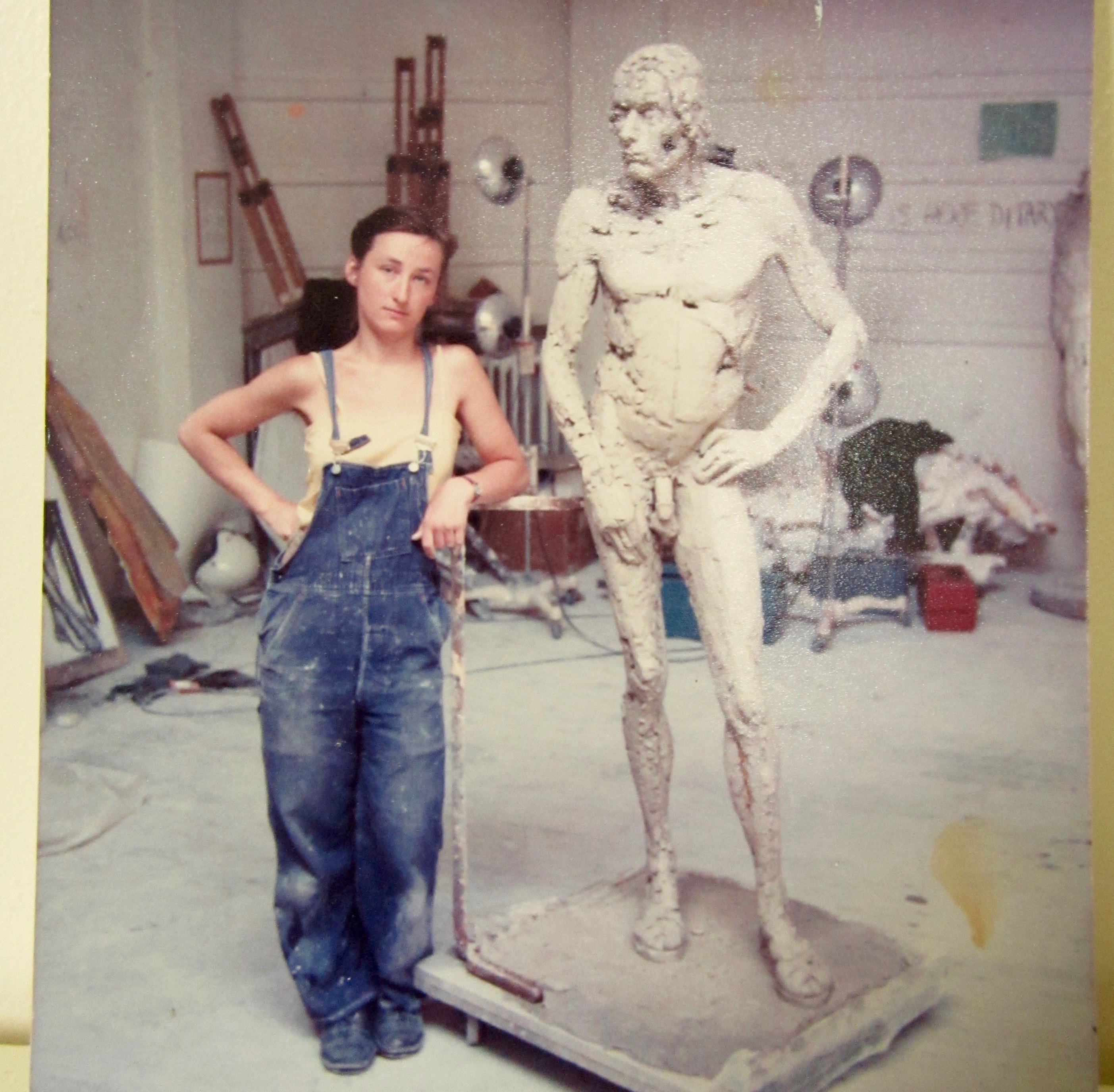
About me
Vanessa Pooley FRBS (Fellow of the British Society of Sculptors)
My bronze sculptures explore the female form and have emerged from a lifelong obsession with representing the female body and its flowing curves and lines.
Even as a young child at nursery, I would repeatedly draw female figures. I loved sketching simple shapes dressed in the triangular-shaped dresses that symbolise ‘female’.
This joyful drawing meant that I looked forward to nursery each day. However, concerned that I should concentrate on ‘proper’ schoolwork such as maths, reading and writing, my teacher insisted I use my pencil for algebra instead or art. I was banned from drawing tiny women in dresses.
But, my obsession with form and figure continued. Aged 10, I dug raw clay from the beach at Walberswick, in Suffolk. Rough and pocketed with stones and sand, it was still malleable enough to sculpt and I took it home to work with.
I formed it into stylised female heads with long, straight noses; cooked them in the oven and then painted them. I even sold one at the local fete. Much later, I went on to make standing female figures from clay, one of which I also sold – albeit to my brother.
Once at sixth form, I discovered ceramics – and again used the medium to work figuratively. Mr Hugh Forward, the Hewett School 6th-form head of art was a kind and encouraging teacher and suggested I join his adult-education ceramics class.
I created autobiographical ceramic sculptures, working out some of my personal issues, I suppose. Some were of groups of figures, as I thought about the various relationships around me.
Art school
After sixth form, I went on to study Sociology at the University of York. The subject seemed a safer and more respectable option than going to art college.
However, it took just one term for me to realise that sociology wasn’t for me. With the help and encouragement of friends and my old teacher Mr Forward I managed to change course and enrol on a Fine Art foundation course at Norwich School of Art.
The lure of trying to represent the female figures in my artwork persisted despite all the other mediums and methods that were on offer at art school. I spent most of my time in the life room alongside the painting-degree students - continuously drawing from the model, an important stage for anyone who wants to work figuratively.
I followed this foundation year with a degree in sculpture, again at Norwich Art School. At that time, the style of work encouraged in most sculpture courses was abstract rather than figurative.
I was in a rebel group of students who organised a model to work from, and the college eventually generously paid the modelling fees.
I experimented with abstract work, unconnected with the figure, but repeatedly my artistic focus returned to the female body. My degree show was all figurative sculptures.
Postgraduate study in London
I enrolled on a postgraduate course at City and Guilds of London Art School, then run by Sir Roger de Grey. The attitude to sculpture was in contrast to Norwich. Indeed, the main sculpture studio was really the life-room and all the sculptors were expected to work on life size figures directly from the model.
At City and Guilds, I learned many of the skills I would need as a bronze sculptor: how to make armatures to hold up the clay or plaster, how to measure and balance the figure and how to make plaster moulds for casting.
The year after graduation, I found living in London tough financially. Thankfully, I took advantage of cheap classes run by colleges like the Sir John Cass, in the East End, where there were clay facilities and models to work from. I continued to work there on sculpture in a small way, making ceramic figures and firing them at the ceramics department – working on my art alongside part time jobs.
First exhibition
In 1984, I organised my first exhibition at Southwark Cathedral. It was challenging but with the help of an older and more experienced artist, I discovered how to create a functioning exhibition.
The solo show was a watershed moment in my artistic career. I sold work for the first time – other than a few pieces I had sold during my schooldays. It gave me an enormous boost of confidence and helped me see it might be possible to work as a professional bronze sculptor.
Professional bronze sculptor
Gradually the exhibition opportunities have increased and galleries in the UK and internationally have invited me to show with them. I have exhibited widely from London, Milan, New York, Hong Kong, Singapore, San Diego, Zurich, Edinburgh, Aldeburgh, Sherborne and in my home-town Norwich.
I continue to get a thrill when people buy my sculptures because I feel it means my work is really appreciated.
I returned to my home county in 1997 and have worked here as a Norfolk-based sculptor ever since. Strangely, my art-therapist husband Tobias and I have ended up in the old house I grew up in – raising our now two grown-up children in the same family home in Norwich.
My obsession continues to this day and I never tire of making sculpture based on the female form, working to portray the female figure as eternal and pleasing without being sentimental.
My aim is to produce work that’s not ephemeral, not an abstract message or a gesture but instead something solid and as simply expressed as possible.
Local and international interest in my work has been fantastic and continues to grow. I now exhibit my patinated bronze figures regularly through several galleries, organise my own exhibitions and occasionally have invitation-only open studios.
My work as a bronze sculptor continues to develop and, at times, I have to pinch myself that I am a sculptor who is free to create the work I want. I never thought it would be possible, but now I can’t imagine doing anything more enjoyable.